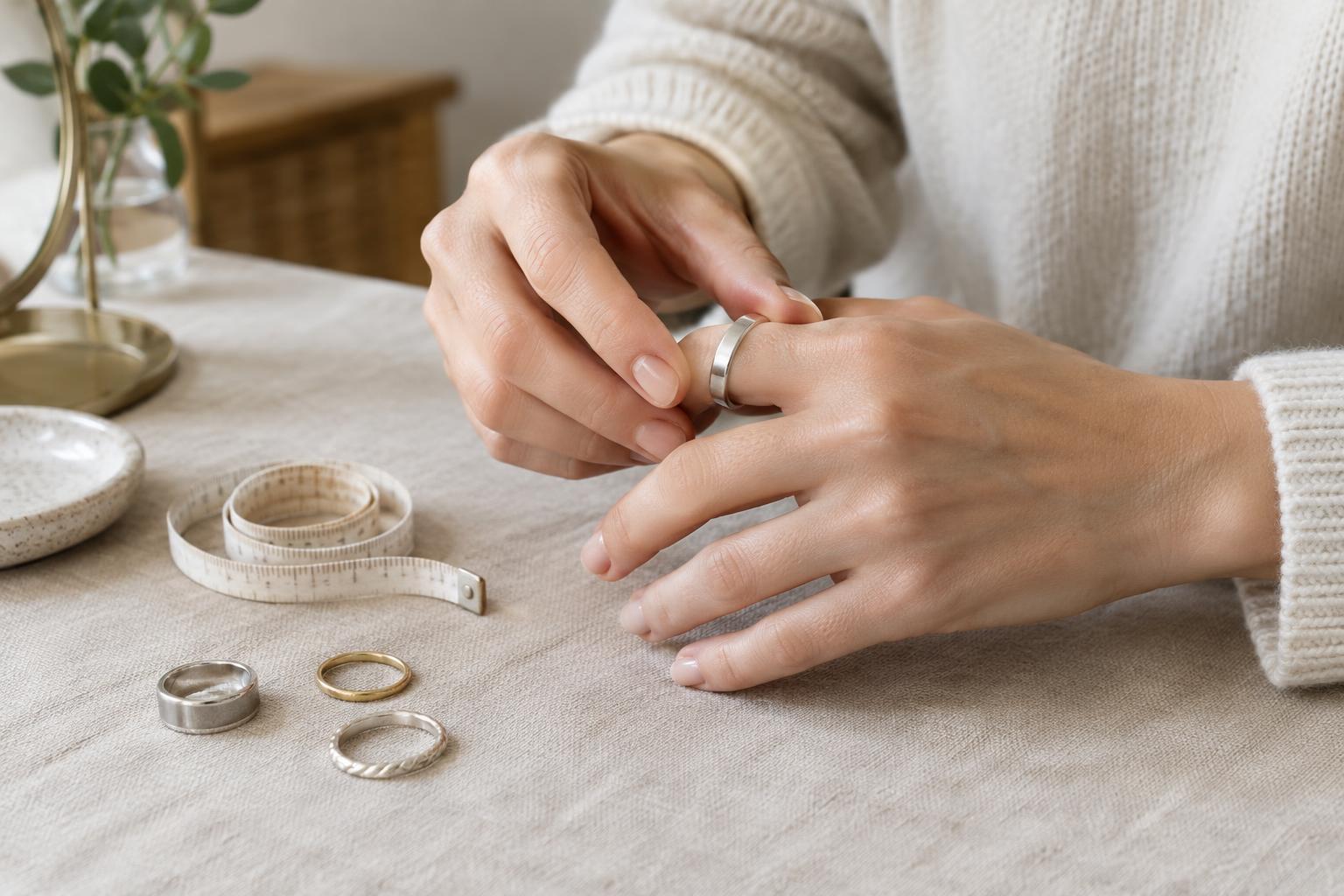
Start with what a good fit feels like
A comfortable everyday ring should go over your knuckle with gentle resistance and sit securely at the base of your finger. It should not pinch when you make a fist, leave a deep mark after ordinary wear, or feel as though it could slip off when your hands are relaxed. A little movement is normal; a ring does not need to stay perfectly still to fit well.
Your knuckle and the base of your finger may be different sizes. If your knuckle is noticeably wider, choose a fit that passes over it without force, then check whether the ring feels too loose once it is on. If it spins constantly or slides toward the fingertip, ask a jeweler about fit options rather than choosing a size that is difficult to remove.
Measure at a typical time of day
Finger size can shift during the day and with changes in temperature or activity. Cold hands may make a ring seem looser; warm hands may make it feel tighter. For an everyday ring, measure when your hands feel comfortable and typical for you, then check the fit on another occasion if possible. Avoid relying on a single measurement taken just after being outdoors in the cold or during an unusually warm spell.
A ring sizer is the clearest way to compare sizes. Try the size you think you need, then its neighbors. Slide each over the knuckle and leave it on briefly while you open and close your hand. The best choice should feel secure without demanding a hard pull to take off. If you are ordering online, follow that seller’s size chart: labeled ring sizes are not interchangeable across every sizing system.
Use an existing ring carefully
A ring you already wear comfortably can be a useful reference, provided it fits the same finger on the same hand. Fingers that look similar may not measure alike, and the corresponding finger on your other hand may need a different size. You can bring the ring to a jeweler for measurement or compare its inside diameter with a seller’s chart. Measure the inside of the band, not its outside edge.
String or paper can give you a rough starting point if no ring sizer is available, but both can stretch, twist or sit more tightly than a ring would. Wrap the strip gently around the finger, mark where it meets and measure it without pulling it taut. Repeat the check and treat the result as an estimate, especially for a ring you cannot easily exchange.
Account for band width and design
Band shape changes how a size feels. A wide band covers more of your finger than a narrow one and may feel snugger even when both carry the same size label. If you plan to wear a broad statement ring or several bands stacked together, try on a similar width before ordering. A smooth, rounded interior may also feel different from a flat interior, so compare the actual design whenever you can.
Think about how you will wear the ring. A delicate band worn alone may allow more movement than a stack that takes up space along the finger. A heavy top can make a slightly loose ring rotate, while a raised setting may catch on clothing. These details do not automatically call for a different size, but they are good reasons to test the ring during ordinary hand movements rather than judging it while your hand is still.
Check your options before committing
If you fall between sizes, consider the season, the width of the band and how the ring feels at both the knuckle and the base of your finger. Do not choose a painfully tight fit to prevent spinning. Equally, a ring that comes off without resistance may be too easy to lose. When possible, try the ring on at more than one time and confirm the shop’s exchange policy before buying.
Ask whether the ring can be resized later. Resizing depends on its material and construction; continuous patterns, stones set around the band and some alternative materials may limit the options. If your finger size changes regularly, an adjustable design or a different finger may be more practical. The aim is not a perfect number on a chart, but a ring you can wear, remove and enjoy comfortably.