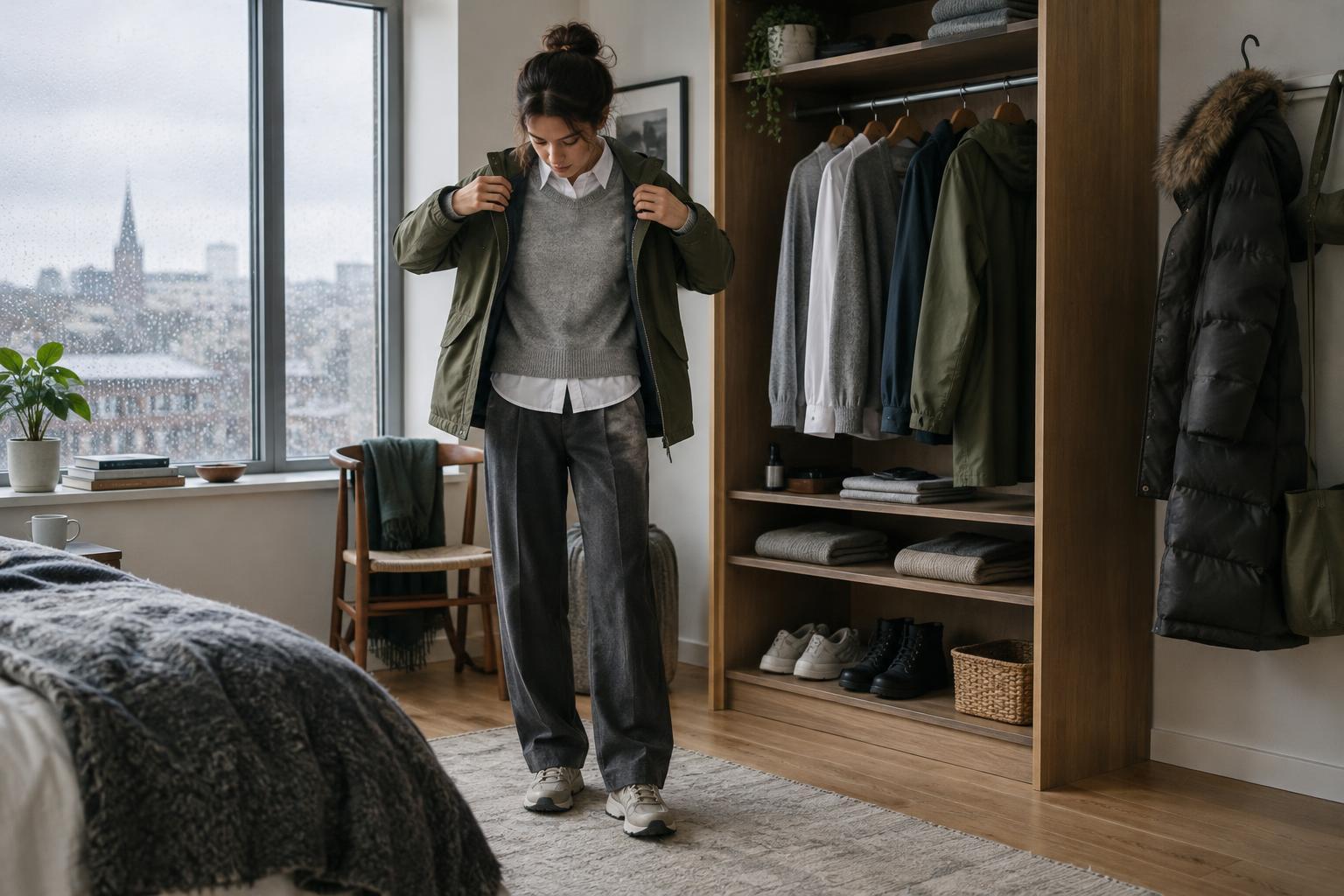
Dress for your days, not a picture of the season
It is easy to imagine summer as nothing but sunshine or winter as a steady run of freezing days. Actual wardrobes have to handle more variety: cool mornings, warm afternoons, rain, wind, heated rooms and trips between them. If you plan around the most recognizable version of a season, you may end up with clothes that look right on a hanger but rarely feel right when you leave home.
Before putting away one season's clothes, think through your usual week. Consider how much time you spend outdoors, whether you walk or drive, and how warm your workplace or other indoor spaces tend to be. Then look at the conditions you commonly dress for, rather than treating an unusually hot or cold day as the standard. This helps you decide which pieces deserve easy access and which can stay in storage until needed.
Do not make every outfit depend on one heavy piece
A thick coat or chunky sweater can be useful, but it offers limited control when temperatures change during the day. One common mistake is choosing an outfit that is only comfortable with its outer layer on. Once indoors, the remaining clothes may feel too light, too warm or unfinished. The same problem appears in warmer months when a light outfit has no option for a breezy evening or an overly cool room.
Build from a comfortable base instead. A breathable top, a shirt or cardigan, and an outer layer give you more ways to adjust. You do not need all three every day; the point is to make each layer useful on its own. Try an outfit on without its jacket before you rely on it. If you would not feel comfortable wearing the middle layers alone, change the combination rather than hoping the weather stays constant.
Give fabrics and fit room to work together
Layers work best when they can move without bunching. A fitted long-sleeve top can sit under a relaxed shirt, while a coat needs enough space through the shoulders and arms to go over both. If every piece is close-fitting, the outfit may feel restrictive. If every piece is bulky, it can become cumbersome. Mixing slimmer and roomier shapes usually makes layering easier.
Fabric choice matters too. A light cotton shirt may be comfortable as a base, while a knit, fleece or overshirt adds warmth that you can remove. A wind-resistant or water-resistant outer layer may be more useful on unsettled days than another thick sweater, depending on your conditions. Check care labels and your own comfort: a fabric that feels pleasant for a brief try-on may not be your favorite for a full day of changing temperatures.
Plan complete outfits, including shoes and small extras
Wardrobe planning often stops at tops and bottoms, leaving shoes and accessories as last-minute decisions. Yet wet sidewalks can change which shoes you want to wear, and an exposed neck or cold hands can make an otherwise sensible outfit feel inadequate. In warm weather, a hat or an easy-to-carry layer can be just as important to your comfort as your main outfit.
Make a few outfit combinations for the conditions you face most often: a mild dry day, a chilly or windy day, and a wet day. Include footwear, socks and any small extras you actually use. This is also a budget-friendly way to spot gaps. You may discover that you need a more versatile outer layer, or that an existing pair of shoes solves the problem without buying anything new.
Keep a flexible wardrobe within reach
An abrupt seasonal swap can hide useful clothes too early. Instead of packing away everything from the previous season, keep a small group of transition pieces accessible. A lightweight knit, an open shirt and a practical jacket can bridge several weeks of mixed conditions. Choose pieces that work with multiple outfits so they earn their place without crowding your closet.
Revisit your choices as you wear them. If a layer stays untouched, ask whether it is uncomfortable, hard to pair or simply stored in the wrong place. If you repeatedly reach for the same jacket, notice what makes it useful: perhaps its weight, pockets or fit over other clothes. Those observations are more valuable than a rigid seasonal checklist. A good seasonal wardrobe is not a perfect set of clothes for every possible day; it is a manageable collection that lets you adapt.