Start with your wrist, not the size label
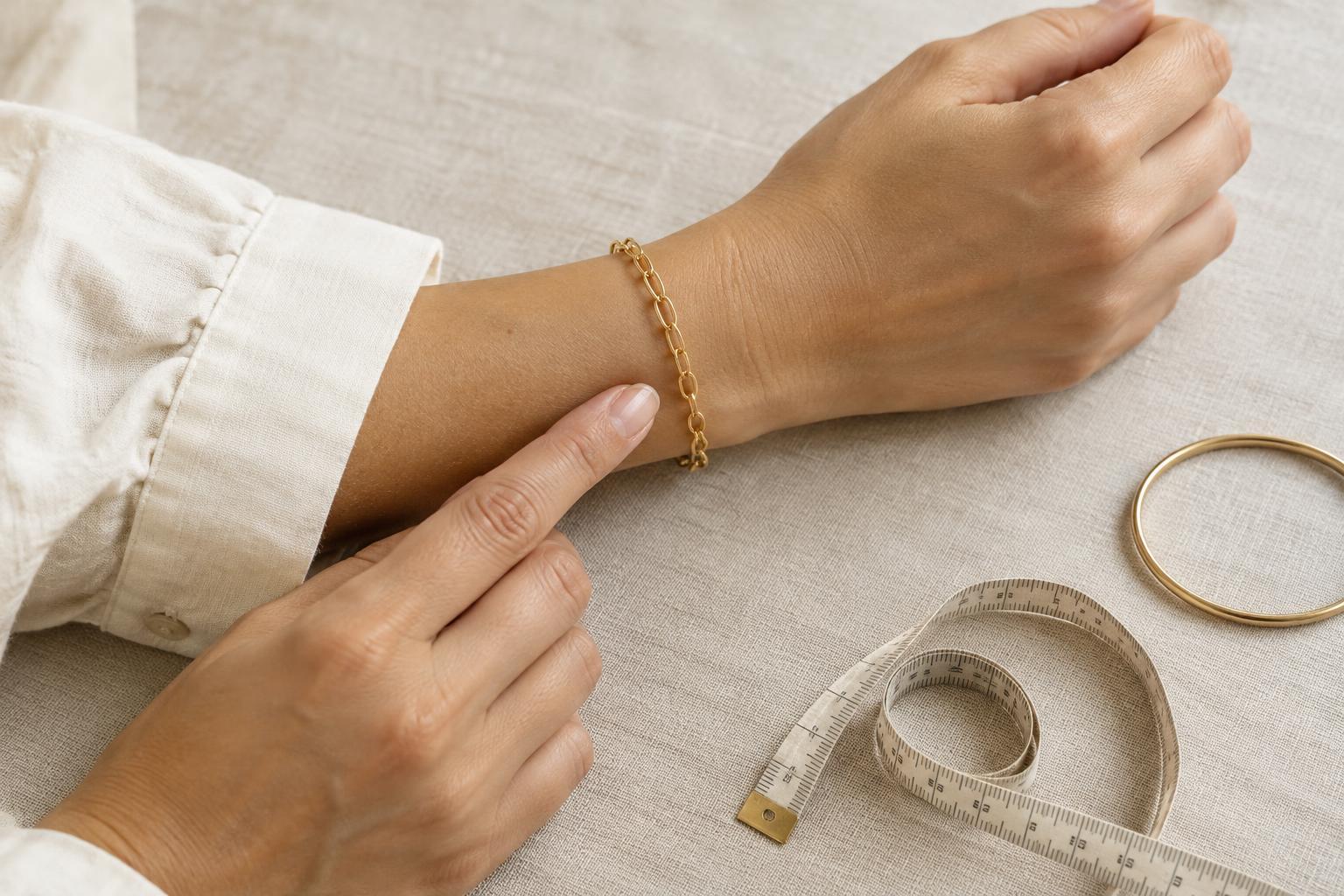
A bracelet can be beautiful and still spend the day slipping over your hand or pressing into your wrist. The best fit depends on both your wrist and the bracelet’s shape, so a size label alone may not tell you enough. Start by wrapping a flexible measuring tape around the part of your wrist where you expect the bracelet to sit. Keep the tape against your skin without pulling it tight. If you do not have a tape, use a strip of paper or string, mark where it meets, and measure that length with a ruler.
Record the measurement, then consider how much movement you enjoy. A close-fitting bracelet should still let you move your hand comfortably; a relaxed one will need more room but may travel farther up and down your arm. If you are shopping online, check whether a listed measurement describes the bracelet’s total length, its wearable length when fastened, or a recommended wrist size. Clasps, thick links and decorative sections can all affect how much usable space a bracelet provides.
Match the fit to the bracelet style
Chain bracelets usually offer the easiest adjustments. A short extender or several clasp positions can help you find a fit that stays near your wrist without pulling when you bend your hand. Beaded bracelets may behave differently even when their listed length matches a chain: large beads take up space on the inside, so they can feel snugger than expected. Elastic designs should stretch enough to pass over your hand without a struggle, then settle on your wrist without constant pressure.
A rigid bangle must pass over the widest part of your hand, so wrist circumference is not its only important measurement. Check the bangle’s inside diameter or opening against a bangle you already find comfortable. Once it is on, notice whether it slides off too easily when your hand points downward. An open cuff offers more flexibility, but its ends should not press into the sides of your wrist. Avoid repeatedly bending a cuff to resize it unless the maker says that is appropriate for its construction.
Do a movement check before deciding
Try a bracelet on with your arm relaxed, then lift your arm, turn your palm up and down, and bend your wrist as you would while typing or reaching into a bag. A little movement is normal. If the bracelet repeatedly drops onto your hand, catches at the base of your thumb or needs frequent repositioning, it may be too loose for everyday wear. If the clasp pulls, the beads leave deep impressions, or you feel pressure when you flex your hand, try more room or a different shape.
Pay attention to the details that touch your skin. A flat clasp may sit more comfortably than a bulky one when your wrist rests on a desk. Smoothly finished links and bead edges are less likely to catch on sleeves. If you plan to stack bracelets, test them together: a comfortable piece worn alone may feel crowded beside a watch or several other bracelets. Leave enough space for each item to move without trapping the others against your wrist.
Choose materials and closures for your routine
Fit is not only about measurements. A heavy bracelet may slide toward your hand more noticeably than a light one of the same length. A wide band spreads contact across more of your wrist, while a narrow chain concentrates it in a smaller area. Consider when you will wear the piece: a bracelet for occasional outfits can tolerate more movement than one you hope to forget about during a full day.
The closure matters, too. Before buying, think about whether you can fasten it yourself and whether it stays secure during ordinary movement. A clasp that is difficult to manage can tempt you to choose an unnecessarily loose size just to get the bracelet on. If your skin is easily irritated by certain materials, look for clear material information and pay particular attention to clasps and other parts that remain in contact with your skin.
Make small adjustments instead of settling
If a bracelet is almost right, an adjustment may be simpler than replacing it. A removable link can shorten some metal designs; an extender can add room to some chains. A bracelet maker or jeweler may be able to advise on alterations when the construction is less straightforward. For beaded or elastic pieces, restringing may change the fit, but the result will depend on the beads, cord and design.
Aim for a bracelet that feels comfortable during the movements you actually make, not one that matches an ideal measurement on paper. Measure first, check how the style is sized, and give yourself a moment to test it on your wrist. The right fit lets the bracelet complement your outfit without asking for your attention all day.